
Easy Way to Get Students to Generalize their R Sound
There’s nothing more frustrating than working with a student who can say their R sound consistently while reading or in structured activities, but is completely oblivious to their R sound in conversations. Because saying R in conversations is the ultimate goal of articulation therapy, carryover of their R sound should be addressed from the very beginning, rather than waiting until a student is close to 100% accurate in structured tasks.
When to start?
Once students can say their R sound accurately in single words most of the time, you can begin to target their ability to generalize the sound to conversations. They will not be close to perfect at this stage—and that’s okay! The goal is to help students notice how often they are saying the R sound. This sound is one of the most commonly said consonant sounds in English, but students are often surprised at how often they are saying it.
What to use?
I’ve seen many speech therapists attempt to correct conversational errors by simply saying, “Say that again.” Students often respond with confusion and repeat the sentence incorrectly. I’ve been guilty of doing this myself, but it’s rarely effective. If correcting speech were that simple, any teacher or parent could do it. Students with articulation disorders need explicit instruction and clear feedback to successfully generalize their R sounds. One effective strategy is to use a visual support that marks the exact moment an R sound is produced correctly or incorrectly.
Even better, this strategy requires only the materials you already have in your speech room! I typically use a whiteboard and marker, but paper and pencil work just as well.
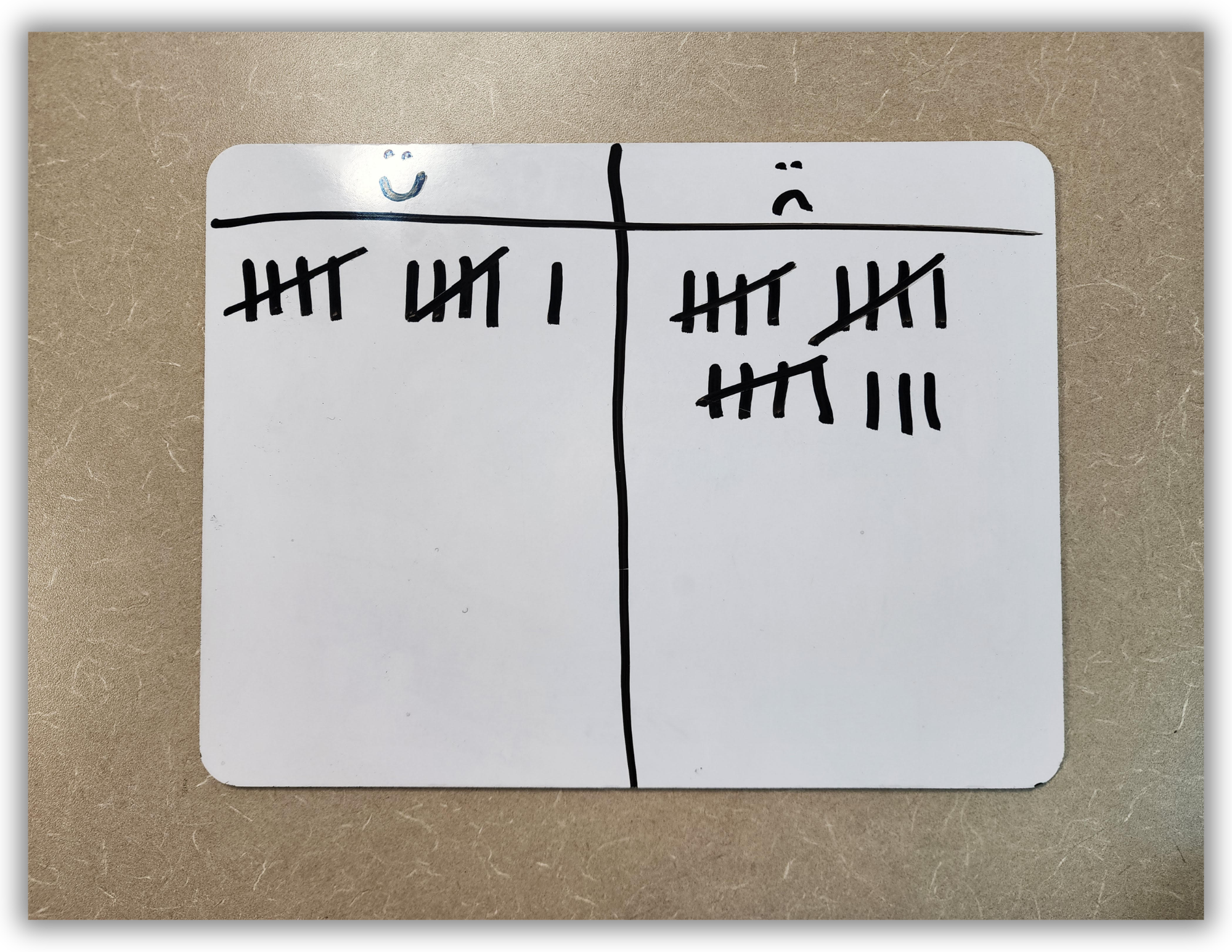
Using a visual helps students see the exact moment they say an R sound correctly or incorrectly. It builds their awareness of the R sound, and it also provides an easy way to keep track of data!
Step-By-Step Instructions
Draw a line down the middle of your whiteboard. On one side, draw a smiley face and on the other side a frowny face.
Tell students, “The goal of speech therapy is to say your R sound while having a conversation. Now that you’re able to say your R in most words, we’re going to practice having a conversation. This is going to be a lot harder than saying R in words. I don’t expect you to get all your R sounds correct. My hope is that you can get even 5% or 10% right.”
Point to the whiteboard and say, “If you say your R sound correctly, I’ll draw a tally on the smiley face side of the whiteboard. If you say your R sound your old way, I’ll draw a tally on the frowny face side.”
Make sure when you do this, you focus on building your student’s confidence. Say, “The point of this isn’t to make you feel bad if you get some wrong. It’s just to help you realize how often you say the R sound and what words you say have R in them. It’s okay to get some tallies on the frowny face side. That’s part of learning. If you see me draw a tally on the frowny face side, try saying the word again with your strong R sound.”
Have your student talk for 1-5 minutes, depending on how fast they talk. Try to get them to say at least 20 different R words at the conversational level.
Once they’re done, talk about how they did and focus on the positives. If they only got one right, congratulate them on that. If they didn’t get any right, focus on how they are now more aware of what words have R in them.
Conversation Topics
Trying to think of good conversation topics with older students can be difficult. Some students will talk your ear off, but some students will stare at you blankly and shrug their shoulders if you ask about their day or how their classes are going. That’s why I create

These back to school conversation starters for R, S, and Z sounds are perfect for helping students generalize their articulation sounds to the conversational level. Students can read the prompts out loud--each prompt has at least two R sounds, and two S or Z sounds in it. Then, students can answer the question for additional articulation practice.
This product includes 80 conversation starter questions! Each one can be used for R, S, or Z sounds. They can be used for other sounds, though the prompts don't specifically target other sounds. Students can read the prompts straight off the page, or you can cut them out and put them into a container for students to draw one out at a time to read.
These articulation conversation questions are perfect for late elementary, middle school, or high school-age students (grades 4-12) who are still working on these sounds in speech therapy.